
 Round
 Oval
 Cushion
 Emerald
 Pear
 Marquise
 Asscher
 Princess
 Radiant
 Heart


Solitaire vs Halo Engagement Rings: Which Style Is Right for You?

A solitaire puts one diamond at the center of everything. A halo surrounds that diamond with smaller stones. Both can be beautiful, but they create very different rings. Here is how to choose the setting that fits your taste, your lifestyle, and the way you want your ring to look every day.
Quick answer
Choose a solitaire engagement ring if you prefer a clean, timeless design that keeps attention on the center diamond.
Choose a halo engagement ring if you want more visible sparkle, a decorative setting, and a larger-looking overall diamond arrangement.
Neither style is automatically better. The right choice depends on how much detail you want around your center stone and how you plan to wear the ring.
Solitaire vs halo engagement rings: What is the difference?
The main difference is what surrounds the center diamond. A traditional solitaire engagement ring features one main diamond without a surrounding halo of smaller diamonds. The design is intentionally simple, allowing the center stone to stand out.
A halo engagement ring places a circle or shaped arrangement of smaller diamonds around the center stone. Those additional diamonds create more sparkle and can make the overall setting appear wider.
Both settings work with round, oval, cushion, pear, radiant, emerald, and many other diamond shapes. The same center diamond can look surprisingly different depending on which setting you choose.
What is a solitaire engagement ring?
A solitaire is one of the most recognizable engagement ring styles. It features a single main diamond as the visual focus, usually supported by a simple band and a prong or bezel setting.
The appeal is restraint. There is no surrounding frame of diamonds competing with the center stone. You notice the shape, the proportions, and the diamond itself.
Why people choose solitaire rings
Solitaire rings are versatile. A round solitaire can feel traditional, an oval solitaire more elongated, and an emerald-cut solitaire architectural and understated. The setting can be minimal without looking plain.
They also tend to be easier to clean than elaborate multi-stone designs because there are fewer small diamonds and intricate areas around the center. However, prongs and the main setting still require periodic inspection.
Something worth knowing: A solitaire does not have to mean a completely plain band. Some designs combine a prominent single center diamond with pavé accents along the shank. The defining visual idea is that the center diamond remains the focus.
What is a halo engagement ring?
A halo engagement ring surrounds its center diamond with smaller diamonds. The arrangement can follow the center stone's shape or create a different outline.
A round center may sit within a round halo. An oval diamond can be surrounded by oval-shaped pavé detailing or a floral arrangement. Some designs use a double halo for an even more decorative appearance.
Why people choose halo rings
A halo adds visual detail and increases the amount of diamond-covered surface visible from above. This often makes the complete setting look larger than a solitaire with the same center diamond.
It also gives designers more room to introduce vintage-inspired, romantic, or highly decorative elements. The trade-off is that the setting usually contains more small stones and more areas that need careful cleaning.
Solitaire vs halo engagement rings: Side-by-side comparison
| Feature | Solitaire Ring | Halo Ring |
|---|---|---|
| Appearance | Clean, minimal, center-focused | Detailed, decorative, diamond-rich |
| Sparkle | Primarily from the center diamond | From the center and surrounding diamonds |
| Visual size | Shows the center diamond's own outline | Can make the overall setting appear larger |
| Maintenance | Generally fewer small-stone settings to inspect | More small stones and intricate areas |
| Style | Classic, understated, versatile | Romantic, ornate, statement-making |
| Wedding band | Some designs allow a flush fit | Fit depends on halo placement and setting height |
| Cost | Often simpler to manufacture | Additional diamonds and setting work may add cost |
| Best suited for | Someone who prefers simplicity | Someone who enjoys extra detail and sparkle |
Which sparkles more: Solitaire or halo?
A halo ring usually has more individual points of sparkle because it includes additional diamonds around the center stone. Those smaller diamonds reflect light from different angles, creating a lively overall appearance.
But that does not necessarily mean the center diamond itself is more brilliant. A well-cut solitaire diamond can display exceptional brightness, fire, and scintillation without surrounding stones.
The difference is where the visual attention goes. A solitaire highlights the optical performance of one diamond. A halo creates a combined effect from multiple diamonds.
Does a halo make an engagement ring look bigger?
Often, yes. A halo extends the visible diamond arrangement beyond the center stone, so the overall setting can appear larger when viewed from above.
This does not change the actual carat weight of the center diamond. A one-carat center stone remains one carat whether it is set in a solitaire or a halo. The surrounding diamonds contribute their own weight and visual spread.
If you want a ring with a prominent appearance without relying entirely on a larger center stone, a halo may be worth considering.
If you prefer the center diamond's natural outline to remain clearly visible, a solitaire may be the better choice.
Which is more expensive: Solitaire or halo engagement rings?
With comparable center diamonds and metals, a halo ring often costs more to manufacture because it requires additional diamonds and more setting work.
However, that does not mean every halo ring costs more than every solitaire. The center diamond's carat weight, cut, color, clarity, shape, metal, and craftsmanship can change the final price substantially.
For example, a solitaire with a larger or higher-graded center diamond can cost more than a halo ring with a smaller center stone.
What should you compare?
Look at the complete specifications rather than comparing only the headline price. Check the center diamond weight, total diamond weight, metal purity, side-stone details, and certification.
For lab-grown diamond engagement rings, compare the same center diamond specifications wherever possible. That makes the difference in setting cost easier to understand.
Which setting is better for everyday wear?
Both solitaire and halo engagement rings can be worn daily when properly designed and maintained. The important differences are setting construction, stone security, and the wearer's routine.
Solitaire maintenance
A simple solitaire generally has fewer small diamonds and fewer tiny crevices to clean. That makes routine maintenance more straightforward. However, the center diamond's prongs should still be checked periodically.
Halo maintenance
Halo settings contain additional small diamonds, often held by delicate prongs or pavé settings. Dirt and product residue can collect around these details, so careful cleaning and regular inspections are particularly useful.
Neither style is maintenance-free. Remove fine jewelry during activities that may subject the ring to hard knocks, and follow the jeweler's cleaning recommendations.
Which style pairs better with a wedding band?
This depends more on the setting profile than on the solitaire or halo label.
A solitaire with a raised center setting may allow a straight wedding band to sit close against it. A low-set solitaire can sometimes leave a gap.
A halo ring may need additional clearance depending on how far the halo extends toward the band. Curved or contoured wedding bands can be useful when a straight band does not sit flush.
Check whether the bands sit flush
Look at the ring's side profile. If the center setting or halo projects into the space where the wedding band would sit, a straight band may leave a gap.
Consider a curved wedding band
A contoured band can follow the outline of the engagement ring and create a more integrated bridal set.
Think about long-term comfort
Try to evaluate both rings together. Two individually comfortable rings may feel different when stacked on the same finger.
How to choose between a solitaire and a halo engagement ring
Start with what you actually want to see on your hand. It is easy to be influenced by photographs, trends, and carat numbers, but the best setting is one you will continue to enjoy wearing.
Choose a solitaire if...
- You prefer clean and simple jewelry.
- You want the center diamond to stand alone.
- You like a timeless, understated appearance.
- You prefer fewer small accent stones.
- You want flexibility when choosing a wedding band, subject to the setting profile.
Choose a halo if...
- You enjoy additional sparkle.
- You want a decorative or romantic setting.
- You prefer a larger-looking overall diamond arrangement.
- You like vintage-inspired details.
- You are comfortable maintaining a more intricate setting.
Three questions worth asking before you buy
1. Do you want to notice the diamond or the entire design? If the center stone is your priority, lean toward a solitaire. If you enjoy the combined effect of many diamonds, consider a halo.
2. How much detail do you wear every day? Look at the jewelry you already own. If you naturally choose simple pieces, a solitaire may feel more like you. If you enjoy ornate jewelry, a halo may be a better match.
3. How will it look beside a wedding band? Consider the complete bridal set, not just the engagement ring on its own.
Explore solitaire and halo engagement rings at Rareva
Rareva offers lab-grown diamond engagement rings in a range of shapes, metals, and settings. These examples show how different the finished appearance can be.
01 / Classic Solitaire
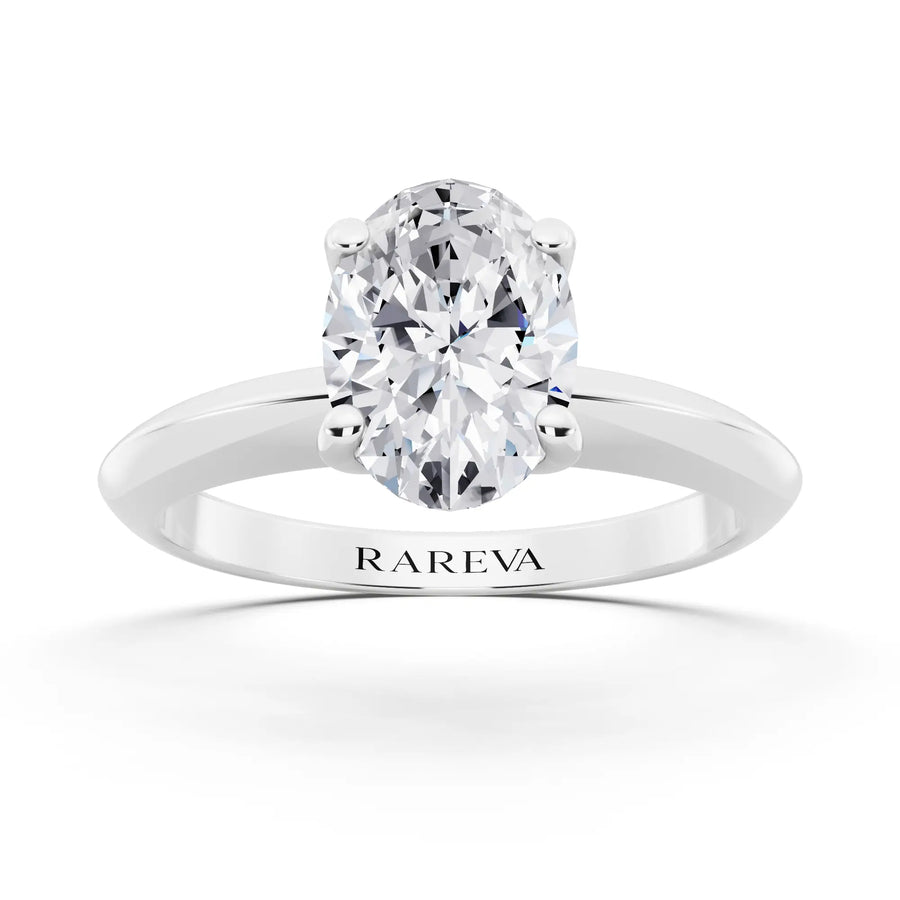
14 KT White Gold Oval Cut Diamond Classic Solitaire Ring
A clean oval-cut center diamond in a white-gold setting. This design keeps the focus on the diamond's elongated outline rather than surrounding decoration.
View Solitaire Ring
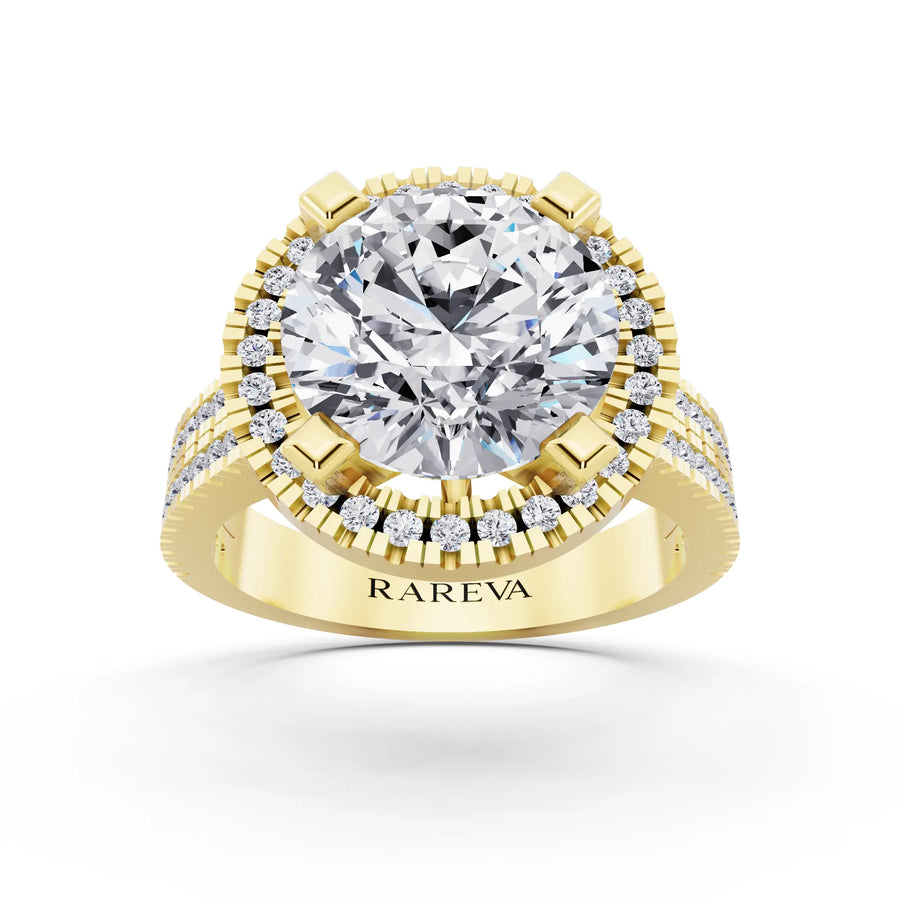
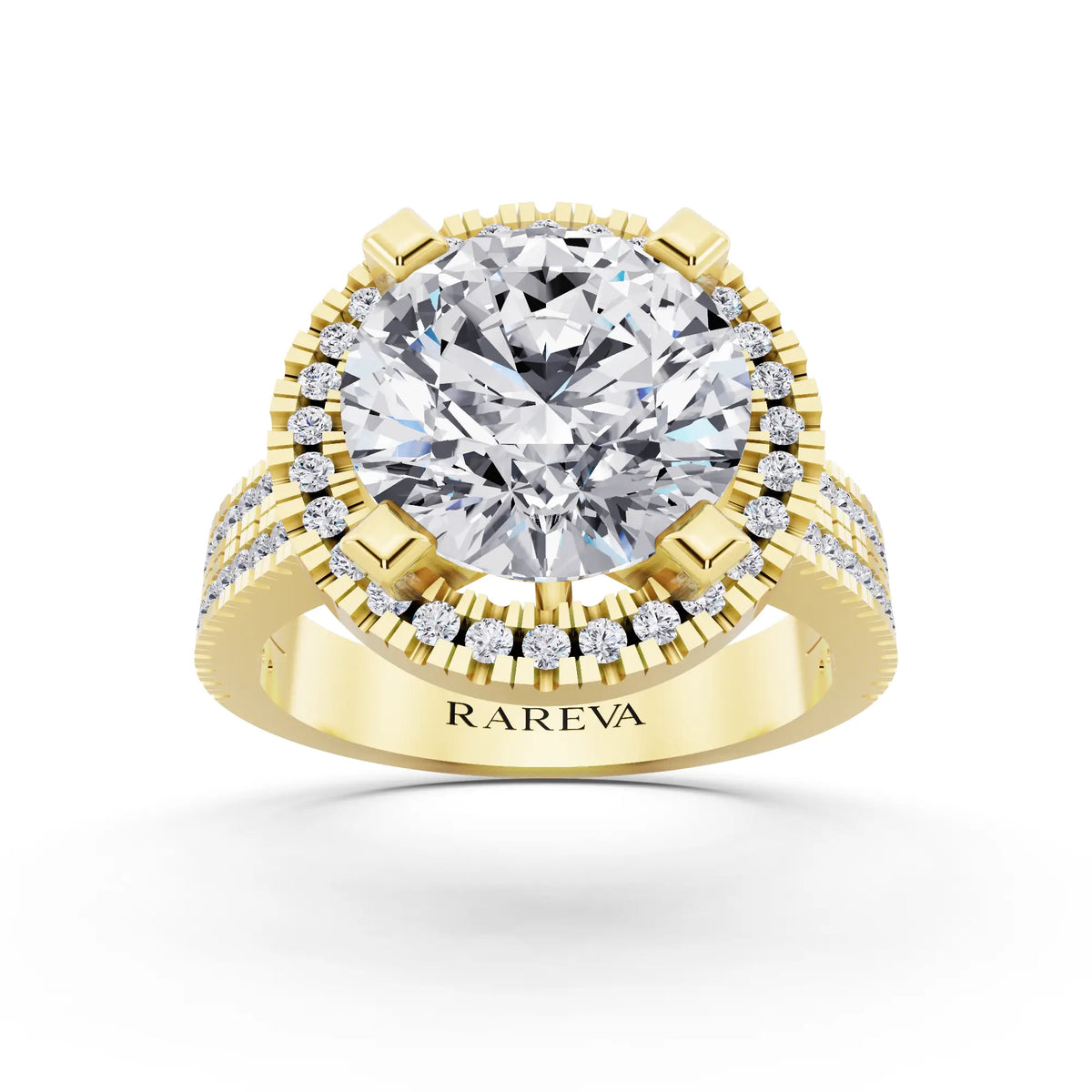
02 / Floral Halo
14 KT Yellow Gold Oval Cut Diamond Floral Halo Ring
A decorative oval design with round diamonds arranged around the center like petals. The polished yellow-gold band provides contrast while keeping the floral halo as the main feature.
View Halo Ring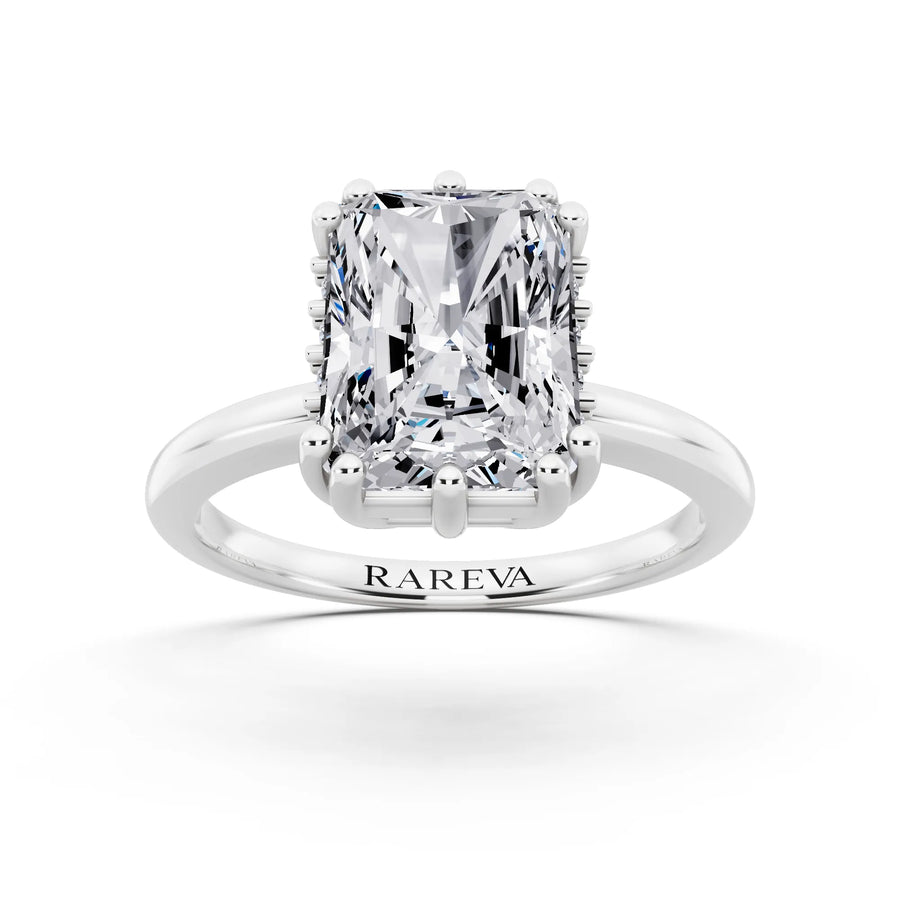
03 / Hidden Halo
18 KT Yellow Gold Emerald Cut Diamond Hidden Halo Solitaire Ring
An emerald-cut center diamond with a hidden halo of smaller diamonds beneath it. The top view stays restrained, while the side profile reveals additional detail.
View Hidden Halo RingFrequently asked questions
Is a solitaire or halo engagement ring more timeless?
Solitaire rings are often associated with timeless, minimal styling. Halo rings also have a long history and can feel classic, particularly in vintage-inspired designs. The better choice depends on your taste.
Does a halo ring make the center diamond look bigger?
A halo can make the overall diamond arrangement look larger by surrounding the center stone with additional diamonds. It does not increase the center diamond's actual carat weight.
Are halo engagement rings more expensive than solitaires?
With otherwise comparable specifications, a halo may cost more because it includes additional diamonds and setting work. However, center diamond quality, size, and metal can have a greater effect on the final price.
Are solitaire rings easier to maintain?
Simple solitaires usually have fewer small stones and intricate areas to clean. Both solitaire and halo settings still need appropriate care and periodic inspection.
Can I use an oval diamond in a halo setting?
Yes. Oval diamonds work with solitaire, visible halo, and hidden halo settings. The setting changes the overall appearance without changing the diamond's oval shape.
What is the difference between a halo and a hidden halo?
A visible halo surrounds the center diamond when viewed from above. A hidden halo places smaller diamonds beneath the center, so the detail is more noticeable from the side.
Is a halo ring suitable for everyday wear?
Yes, provided the setting is well made and properly maintained. Halo rings contain more small diamonds and setting details, so regular cleaning and inspections are important.
Which is better for a lab-grown diamond?
Both styles work well with lab-grown diamonds. Lab-grown and mined diamonds have the same fundamental physical and optical properties. Choose the setting based on design preference, not diamond origin.
Can a solitaire or halo ring sit flush with a wedding band?
Either style may or may not sit flush. It depends on the center setting's height, the halo's position, and the wedding band's shape. Check the side profile or try the rings together before ordering.
Final thoughts: Which engagement ring style should you choose?
Choose a solitaire if you want one diamond to do the talking. Its simplicity makes the center stone the main feature, and the design works across a wide range of diamond shapes and metals.
Choose a halo if you want a more detailed ring with additional sparkle and a larger-looking diamond arrangement. It offers more opportunities for decorative design and a distinctive overall silhouette.
And if you find yourself somewhere between the two, consider a hidden halo. It keeps the top view relatively clean while adding detail beneath the diamond.
There is no universally better choice. The right engagement ring is the one that feels natural on your hand and fits the way you want to wear it.
Find the setting that feels like yours
Explore Rareva's lab-grown diamond engagement rings in solitaire, halo, and hidden halo designs. Compare diamond shapes, metals, and settings before choosing your ring.
Explore Engagement RingsFROM OUR OWN REACTORS
See a stone before you choose it.
Nothing on a screen replaces two diamonds side by side under a loupe. Come to the showroom on 47th Street, or start with the collection.


